Discourse 162 – God's second creation.
The interpretation of a biblical passage.
The soul of the living creature.
The alleged immortality of the soul
The spirit of the human being
Human beings as spiritual beings: the second creation of God
The dangers for earthly-minded "soul-centered" people
The separation of soul and spirit by the Word of God
Marrow and bone
The interpretation of a biblical passage
(Texts in a black frame are quotations from visitors to this site or from other authors.)
A service from the Zentrum für evangelische Gottesdienst- und Predigtkultur [the Center for Protestant Worship and Preaching Culture]r
"12 For the word of God is alive and active. Sharper than any double-edged sword, it penetrates even
to dividing soul and spirit, joints and marrow; it judges the thoughts and attitudes of the heart.
13 Nothing in
all creation is hidden from God’s sight. Everything is uncovered and laid bare before the eyes of him to whom we
must give account."
How separation effects healing – a sermon on Hebrews 4,12-13 by Ulrich Kappes
"The word of God is sharper than any double-edged sword…"
How do we understand these words? Can
they stay with us through the new week? Is it a text that we might well prefer to skip because it is painful?
Let us say this much in advance. These words which bring together Christ and the image of the sword are not a
special case in the New Testament. In his address to the disciples when he sent them out into the world, Christ
said, according to Matthew 10: "Do not suppose that I have come to bring peace to the earth. I did not come to bring
peace, but a sword" (verse 34). The seer of Revelation sees the judge of this world and describes him in these
words: "Coming out of his mouth was a sharp, double-edged sword" (1:16). Other texts could be cited. The words we
have before us today are part of a source in the New Testament that contains the figurative image of the sword.
"For the word of God is alive and active. Sharper than any double-edged sword…" That is the message of the first
verse. This is followed by the admonition to render account to God with a clear conscience. So it is about the
effect of God’s word on us, and then about the way in which we relate to the word of God.
(…)
Pastor (retd.) Dr. Ulrich Kappes
These statements by Dr. Ulrich Kappes are quite interesting, but if the reader is curious for an
explanation of the two substantives "soul and spirit", apart from the Bible quotation at the beginning of the above
commentary he will find them mentioned only once more, towards the middle of the article. But even there we find only
the bare biblical text, which is just quoted once again. The subsequent elucidation does speak of the "sharpness of the
sword" and asks "In what way does the Word of God ‘divide’?", but the two words "soul and spirit" are subsequently
avoided and any explanation is quite lacking.
Now of course it is all very well to expound the effect of the
Word of God on the soul and spirit. But perhaps we should first explain what is actually meant by "soul and spirit", and
only then ask why these two can be separated or divided by the Word of God. That is the reason why I have quoted the
above commentary, because it is typical of many such explanations of this biblical passage.
The soul of living beings.
But if we are a little more curious and want to know what the soul and spirit, which are supposed to be
separated, actually are, the Bible does offer us some answers. According to the Old Testament, the soul is the blood of
a living being:
Denn was die Seele alles Fleisches betrifft: sein Blut, das ist seine Seele.
Lev 17,11 For the life of a creature is in the blood, and I have given it
to you to make atonement for yourselves on the altar;It is the blood that makes atonement through the soul (in him).
17,12 Therefore I say to the Israelites, ‘None of you may eat blood, nor may any foreigner residing among you eat
blood.’ Lev 17,11-12;
And here we also get – in passing, as it were – a partial answer to one of the biggest questions of
Christianity: How could the sins of all the people of this world be atoned for through the death of the Son of God on
the cross, if they accept it in faith as atonement for their sins? God himself reveals it to us here when he says: "And
I have given it to you to make atonement for yourselves on the altar".
"It is the blood that makes atonement through the soul (in him)."
And this is likewise the background to the animal sacrifices in the Old Testament: "to obtain atonement
for our souls". Instead of our own soul, another soul must die for our sins. However, it remains an open question
whether God commanded this animal sacrifice in order to test whether people really wanted to repent for their sins, and
whether they were prepared to sacrifice a not inconsiderable part of their wealth – since after all, animals were much
more valuable back then than they are today.
Or are we rather to suppose that when the sinner places his hand on
the head of the sacrificial animal before it is slaughtered, a transfer of guilt for sins actually takes place, so that
a kind of "copy" of this person dies and God’s commandment is thereby fulfilled? The redeeming sacrifice of our Lord
Jesus Christ for the sins of all people would seem to support this idea. But let us return to our topic.
Because the blood is the soul, and you must not eat the soul with the meat.
Deut 12,23 But be sure you do not eat the blood, because the blood is the
soul, and you must not eat the soul with the meat. 12,24 You must not eat the blood; pour it out on the ground
like water. 12,25 Do not eat it, so that it may go well with you and your children after you, because you will be doing
what is right in the eyes of the Lord. Deut 12,23-25;
Taking into account what has been said above, we can recognize here the whole reality of the soul
itself, and its eminent importance before and for the Lord God. Sin, the offense against God’s commandments, must be
punished, and the sinner – his soul – must die. But so that the person does not have to die, while the sin is still
atoned for, the soul of an animal must die in his place.
And at this point we can also at once dispel the
widespread erroneous idea that the soul is "immortal". No, according to the Word of God, the soul is the blood and is
shed with the blood when the living being dies. And from the above scriptural statements we can also recognize that not
only do we humans have a soul, but all living beings whose bodies are animated by blood have a soul! What distinguishes
humans from animals and is actually immortal is their spirit, as we will see presently.
(See also Discourse 22: "Is there such a thing as the immortality of the soul?")
Finally, in the New Testament, in 1 Corinthians 15:45, we have a biblical text that confirms the above
interpretation and leads us straight on to the next topic: the spirit.
«The first man, Adam, became a living soul.» The last Adam became a life-giving spirit.
1Cor 15,45 So also it is written, «The first man, Adam, became a living soul.» The last Adam (symbolically for Jesus Christ) became a life-giving spirit. 15,46
However, the spiritual is not first, but the natural (the soul), then the spiritual. 15,47 The first man is from the earth, earthy; the second man is from heaven. 15,48 As is the earthy, so also are those who are earthy; and as is the heavenly, so also are those who are heavenly. 15,49 Just as we have borne the image of the earthy, we will also bear the image of the heavenly. 1Cor 15,45-49;
The alleged immortality of the soul.
The alleged immortality of the soul.
• According to the Scriptures, there is no such thing as the
immortality of the soul, seeing that the soul dissolves on the death of the human being (flesh, blood).
• For the soul of the flesh is in the blood.
Lev 17,11 "For the soul of the flesh is in the blood,
and I have given it to you on the altar to make atonement for your souls;
for it is the blood by reason of the soul that makes atonement." Lev 17,11;
• The "total-death"-theory is incorrect because, according to Scripture, there
is a "realm of the dead" in which the Lord preached the gospel to the spirits of the dead after his physical death and,
as a result, someone – presumably the spirits of the dead – must be there (1Pet 4,6).
• There are two more or less opposed forces dwelling within the
human being:
– the soul (Hebrew nephesh, Greek psyche): i.e. the
flesh, the blood, but also the human being or person, which perishes after death; and
– the spirit (Hebrew ruach, Greek pneuma): i.e. air, wind,
breath (breath of life) but also the spirit, which after death leaves the body – probably through
the nose (Gen 2:7) – and continues to exist.
Then the Lord God formed a man from the dust of the ground and breathed into his nostrils
the breath of life, and the man became a living being.
Gen 2,7 Then the Lord God formed a man from the dust of the ground
and breathed into his nostrils the breath of life, and the man became a living being. Gen 2, 7;

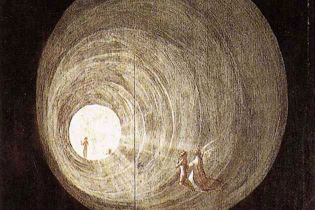
At the death of the human being the spirit leaves the body through the nose.
Thereby he sees at the "end of the tunnel " the illumination of the room in which the dead body lies.
• "The Spirit gives life; the flesh counts for nothing."
(Jn 6:63)
As the body without the spirit is dead, so faith without deeds is dead.
(Jak 2,26)
I declare to you, brothers and sisters, that flesh and blood cannot inherit the kingdom of God.
(1Cor 15:50)
When you hide your face, they are terrified; when you take away their breath, they die and return to the dust.
(Sal 104:29)
For Christ also suffered once for sins, the righteous for the unrighteous, to bring you to God. He was put to death in
the body but made alive in the Spirit.
(1Pet 3:18)
For this is the reason the gospel was preached even to those who are now dead, so that they might be judged according to
human standards in regard to the body, but live according to God in regard to the spirit.
(1Pet 4:6)
• Therefore, it is not the soul, but the spirit of man which, after the
death of the body, passes through the nose (Gen 2,7) into the realm of the dead, where it awaits resurrection and
rebirth out of the spirit.
The dust returns to the ground it came from, and the spirit returns to God who gave it.
Ecc 12,6 Remember him – before the silver cord is severed, and the golden bowl is broken; before the pitcher is shattered at the spring, and the wheel broken at the well, 12,7 and the dust returns to the ground it came from, and the spirit returns to God who gave it.; Ecc 12,6-7;
|
The spirit of the human being
By contrast with Paul in 1Cor 15,45 above, who speaks of man as a heavenly spirit being, here below, in
Gen 2,7, we have to do with the spirit of (earthly, physical) man. This gives us the answer to the question where the
human spirit comes from in the first place:
Then the Lord God formed a man from the dust of the ground and breathed into his nostrils
the breath of life.
Gen 2,7 Then the Lord God formed a man from the dust of the ground and
breathed into his nostrils the breath of life, and the man became a living being. Gen 2, 7;
When you hide your face, they are terrified; when you take away their breath, they die
and return to the dust.
Ps 104,29 When you hide your face, they are terrified; when you take away
their breath, they die and return to the dust. 104,30 When you send your Spirit, they are created, and you
renew the face of the ground. Ps 104,29-30;
So it is God the LORD who blew the "breath of life", the spirit, into the nose of the first man, Adam.
This is the origin of the human spirit: the Lord God. Subsequently, it is man who begets his offspring and passes on his
biological genetic material, and God gives each child after birth a completely neutral, virgin spirit. However, this
spirit subsequently develops in different ways in different people.
Our God is above all a just God – indeed he
is, so to speak, "justice in person". And this absolute justice is based on freedom. There is no true justice without
freedom and therefore human beings have the freedom to shape and develop their spirit according to their own will
through their behavior in the rest of their lives.
Since there is no compulsion of any kind weighing on them,
this is also the reason why the vast majority of people take no further interest in God. The Bible also refers to these
people as "natural" (literally: "soulish") people. For them, soul feelings have the upper hand and the spirit (the
heavenly spirit) gradually wastes away.
The person without the Spirit (literally: "soulish")
does not accept the things that come from the Spirit of God.
1Cor 2,13 This is what we speak, not in words taught us by human wisdom but in
words taught by the Spirit, explaining spiritual realities with Spirit-taught words. 2,14 The person
without the Spirit (literally: "soulish") does not accept the things that come from the
Spirit of God but considers them foolishness, and cannot understand them because they are discerned only
through the Spirit. 2,15 The person with the Spirit makes judgments about all things, but such a person is not
subject to merely human judgments, 1Cor 2,13-15;
However, those people who take an interest in the Bible in the course of their lives will have their
spirit spiritually "fertilized" or "impregnated" by the Word of God (see Luke 8,11 below: "This is the meaning of the
parable: the seed is the word of God"), and so will receive the Holy Spirit. Similarly to a human egg after
fertilization or engendering, the human spirit also continues to develop in knowledge after it has been "fertilized" by
the Word of God, the Bible.
In contrast to the egg, however, which is only ever ready for fertilization for a
short time, the human spirit remains receptive throughout a person’s life and waits to be fertilized – in writing,
verbally or in any other way, through the Word of God. If a person begins to take an interest in the Word of God during
his life, it is very likely that his spirit will be fertilized by the Word of God in the course of this time and so
spiritually begotten or engendered.
However, this is not yet a "rebirth", as many wrongly believe, but merely an
engendering or begetting, so neither is it yet an absolute certainty of being saved. The rebirth from the spirit only
takes place after the death of the person, at their resurrection or raising from the dead. The fertilized spirit of the
believer is therefore "pregnant", so to speak, throughout his entire life, until his death. The brain is the "womb"
where the spirit continues to develop in the course of a person’s life.
And just as there can still be all kinds
of problems in a human pregnancy right up to birth, even including the possibility of stillbirth, situations can also
still arise (Eph 4:14) in a person’s spiritual "pregnancy" where faithful Christians of many years’ standing suddenly
fall away from the faith and are lost (Heb 6:4-6;).
(See also Discourse 85: "True and false Rebirth.")
This lack of any compulsion in people’s lives to think about God, or about their origins and
future, means that appeals such as this one will be received very differently. Some people do not read such texts at
all, others perhaps do read them, but are exposed to the most diverse influences, which in the end lead them to more or
less forget the message.
The following parable of the Lord Jesus shows very clearly the various ways in which the
content of faith, once received, can be lost again.
But the seed on good soil stands for those with a noble and good heart, who hear the word, retain
it, and by persevering produce a crop.
Lk 8,4 While a large crowd was gathering
and people were coming to Jesus from town after town, he told this parable: 8,5 ‘A farmer went out to sow his seed. As
he was scattering the seed, some fell along the path; it was trampled on, and the birds ate it up. 8,6 Some fell on
rocky ground, and when it came up, the plants withered because they had no moisture. 8,7 Other seed fell among thorns,
which grew up with it and choked the plants. 8,8 Still other seed fell on good soil. It came up and yielded a
crop, a hundred times more than was sown.’ When he said this, he called out, ‘Whoever has ears to hear, let them hear.’
8,9 His disciples asked him what this parable meant. 8,10 He said, ‘The knowledge of the secrets of the kingdom of God
has been given to you, but to others I speak in parables, so that, ‘ "though seeing, they may not see; though hearing,
they may not understand." 8,11 ‘This is the meaning of the parable: the seed is the word of God. 8,12 Those along the
path are the ones who hear, and then the devil comes and takes away the word from their hearts, so that they may not
believe and be saved. 8,13 Those on the rocky ground are the ones who receive the word with joy when they hear it, but
they have no root. They believe for a while, but in the time of testing they fall away. 8,14 The seed that fell among
thorns stands for those who hear, but as they go on their way they are choked by life’s worries, riches and pleasures,
and they do not mature. 8,15 But the seed on good soil stands for those with a noble and good heart, who hear
the word, retain it, and by persevering produce a crop. Lk 8,4-15;
With particular reference to this parable of the Lord’s, however, we are obliged at this point to remark
that today’s worldly Christianity is already so entrenched in its false roots that it is almost impossible, regrettably,
to imagine it turning away and repenting. It is sad to see how supposedly Christian people strictly set themselves off
from one another: "I am Catholic", "I am Protestant", "I am Methodist", "I belong to a free church", "I am a Mennonite"
and so on and so on.
This need for differentiation results from the various interpretations of biblical teaching
that they favor. And these are all to some extent non-biblical interpretations – otherwise of course there would be no
need to differentiate. But of course these are just religions with their own liturgies (from the ancient Greek
λειτουργία / ‘leiturgía’, meaning "leadership, public service"), and each religion has its own "catechism", which
differs from the Bible and therefore needs to be codified.
As opposed to this worldly Christianity, biblical
Christianity has no deviating interpretation of biblical teaching and hence does not need to set itself off from other
creeds – at most it can define itself as biblical Christianity as opposed to worldly Christianity. And so this biblical
Christianity is not a religion, either, but a relation, i.e. a connection or relationship with our Father in heaven and
his Son, our Lord Jesus Christ.
Where, in your case, has the seed landed? Among the thorns? Along the path or on rocky ground?
You can still correct it. Don’t get it wrong, for your life depends on it.
Jn 3,36 Whoever believes in the Son has eternal life, but
whoever rejects the Son will not see life, for God’s wrath remains on them. Jn 3,36;
Jn 11,25 Jesus said to her, ‘I am the resurrection and the life. The one
who believes in me will live, even though they die; 11,26 and whoever lives by believing in me will never die.
Do you believe this?’ Jn 11,25-26;
Jn 12,44 Then Jesus cried out, ‘Whoever believes in me does not
believe in me only, but in the one who sent me. Jh 12,44;
Jn 12,46 I have come into the world as a light, so that no-one who
believes in me should stay in darkness. 12,47 ‘If anyone hears my words but does not keep them, I do not judge
that person. For I did not come to judge the world, but to save the world. Jn 12,46-47;
God is spirit, and his worshippers must worship in the Spirit and in truth.’
Jn 4,2323 Yet a time is coming and has now come when the true worshippers
will worship the Father in the Spirit and in truth, for they are the kind of worshippers the Father seeks.
4,24 God is spirit, and his worshippers must worship in the Spirit and in truth.’ Jn 4,23-24;
But you, when you pray, go into your inner room and
pray to your Father who is in secret.
Mt 6,5 "When you pray, you are not to be
like the hypocrites; for they love to stand and pray in the synagogues and
on the street corners (or in front of the Catholic idolatrous altars ["Mary", "Saints"] and the Jewish
"Wailing Wall"!/ FH) so that they
may be seen by men. Truly I say to you, they have their reward in full.
6,6 "But you, when you pray, go into your inner room, close your door
and pray to your Father who is in secret, and your Father who sees
what is done in secret will reward you. 6,7 "And when you are praying, do
not use meaningless repetition as the Gentiles do, for they suppose that
they will be heard for their many words. 6,8 "So do not be like them;
for your Father knows what you need before you ask Him. Mt 6,5-8;
Yet to all who did receive him, to those who believed in his name, he gave the right to become
children of God.
Jn 1,10 10 He was in the world, and though the world was made through him, the
world did not recognize him. 1,11 He came to that which was his own, but his own did not receive him. 1,12 Yet
to all who did receive him, to those who believed in his name, he gave the right to become children of God – 1,13 children born not of natural descent, nor of human decision or a husband’s will, but are begotten1)) of God. Jn 1,10-13;
(See also Short text: "From child of man to child of God")
The Spirit Himself testifies with our spirit that we
are children of God.
Rom 8,16 The Spirit Himself testifies with our spirit that we
are children of God. 8,17 Now if we are children, then we are heirs – heirs of God and co-heirs with Christ, if
indeed we share in his sufferings in order that we may also share in his glory. Rom 8,16-17;
Do you not know that you are a temple
of God and that the Spirit of God dwells in you?
1Cor 3,16 Do you not know that you
are a temple of God and that the Spirit of God dwells in you?
3,17 If any man destroys the temple of God, God will destroy him, for the
temple of God is holy, and that is what you are. 1Cor 3,16-17;
(See also Discourse 126: "Are all religions equal? – the position of Biblical Christianity.")
Paul likewise confirms for us in 1Cor 3,16, quoted above, that the Spirit of God dwells in us, the
children of God, and that we are the temple of God.
The second creation of God
Concealed for two thousand years by mistranslation and incorrect interpretation – and now rediscovered.
«The first man, Adam, became a living soul.» The last Adam became a life-giving spirit.
1Cor 15,45 So also it is written, «The first man, Adam, became a living soul.» The last Adam (symbolically for Jesus Christ) became a life-giving spirit. 15,46 However, the spiritual is not first, but the natural (the soul), then the spiritual. 15,47 The first man is from the earth, earthy; the second man is from heaven. 15,48 As is the earthy, so also are those who are earthy; and as is the heavenly, so also are those who are heavenly. 15,49 Just as we have borne the image of the earthy, we will also bear the image of the heavenly. 1Cor 15,45-49;
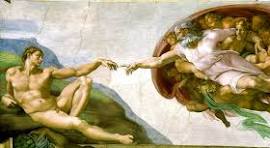
The creation of Adam WIKIPEDIA
By the "last Adam", in 1Cor 15:45 above, Paul means the Lord Jesus, who – after death and rebirth in the resurrection – became a spiritual being, like all the inhabitants of the kingdom of God, the spiritual, timeless and
eternal dimension beyond this world. Through his death on the cross, he saved those who believe in him and "made them
alive".
However, this biblical passage most notably makes a very important statement. Namely in what it says
about the second creation of God. Adam was the "first man" that God created, Jesus Christ is the
"second and last man" that God created. This time not from the dust of the ground, but – in a completely normal,
creation-appropriate way – from a human woman.
And just as Adam documents for us the development of the earthly,
physical human race, the life of the Son of God shows us the progression of the future spiritual people of the
population of heaven (here "spiritual" is meant in the literal sense, as referring to spiritual beings). Of course not
when it comes to the crucifixion, that is an act that could only and exclusively be accomplished by the Son of God. But
with his death, his stay in the realm of the dead - in his case shortened to just three days - (and actually already
"spirit realm", because the dead body remains on earth), then his rebirth in the resurrection / raising from the dead
and his entry into the kingdom of God.
Spiritual people have other characteristics as well, and the Lord has not left
us in the dark about this either: you just have to read and understand his statements correctly. As Jesus explained to
the member of the Sanhedrin, Nicodemus:
«Truly, truly, I say to you, unless one is born again he cannot see the kingdom of God.»
Jn 3,1 Now there was a man of the Pharisees, named Nicodemus, a ruler of the
Jews; 3,2 this man came to Jesus by night and said to Him, "Rabbi, we know that You have come from God as a teacher; for
no one can do these signs that You do unless God is with him." 3,3 Jesus answered and said to him, «Truly, truly, I say to you, unless one is born again he cannot see the kingdom of God.»
3,4 Nicodemus said to Him, "How can a man be born when he is old? He cannot enter a second time into his mother’s womb and be born, can he?" 3,5 Jesus answered, «Truly, truly, I say to you, unless one is born of water and the Spirit he cannot enter into the
kingdom of God. 3,6 That which is born of the flesh is flesh, and that which is born of the Spirit is spirit. 3,7 Do not be amazed that I said to you,
‘You must be born again.’ 3,8 The wind blows where it wishes and you hear the sound of it, but do not know where it comes from and where it is going; so is everyone who is born of the Spirit.» Jn 3, 1- 8;
While the individual Christian denominations argue with one another about what the Lord could possibly
have meant by this statement, actually he is just referring to the two births here: that of the first Adam and his
descendants and of the second/last Adam and his descendants. The first Adam – the physical, earthly man – is born from
his mother at birth, born of water (amniotic fluid). The second Adam – the spiritual, heavenly man – is born of the
spirit on his rebirth, after death and resurrection.
When it comes to the Lord’s statement above in Jn 3:8, "The
wind blows where it wishes and you hear the sound of it, but do not know where it comes from and where it is going; so
is everyone who is born of the Spirit", people invent the most far-fetched interpretations just to avoid
reading what the text actually says. The Lord himself actually gave us two demonstrations of what is meant. After his
resurrection, he appeared to the disciples twice, and each time the disciples had locked the doors for fear that the
Pharisees would come for them, because they were disciples of the crucified Jesus. And both times Jesus suddenly stood
among them "when the doors were shut", i.e. he must have come through the walls.
When it was evening on that day, the first day of the week, and when the doors were shut
where the disciples were, for fear of the Jews, Jesus came and stood in their midst and said to them, "Peace be with
you.".
Jn 20,19 So when it was evening on that day, the first day of the week, and when the doors were shut where the disciples were, for fear of the Jews, Jesus came and stood in their midst and said to them, "Peace be with you." 20,20 And when He had said this, He showed them both His hands and His side. The disciples then rejoiced when they saw the Lord. 20,21 So Jesus said to them again, "Peace be with you; as the Father has sent Me, I also send you." 20,22 And when He had said this, He breathed on them and said to them, "Receive the Holy Spirit. 20,23 If you forgive the sins of any, their sins have been forgiven them; if you retain the sins of any, they have been retained." 20,24 Now Thomas (also known as Didymus), one of the Twelve, was not with the disciples when Jesus came. 20,25 So the other disciples told him, ‘We have seen the Lord!’ But he said to them, ‘Unless I see the nail marks in his hands and put my finger where the nails were, and put my hand into his side, I will not believe.’ Jn 20,19-25;
After eight days His disciples were again inside, and Thomas with them. Jesus came, the
doors having been shut, and stood in their midst and said, "Peace be with you."
Jn 20,26 After eight days His disciples were again
inside, and Thomas with them. Jesus came, the doors having been shut, and stood
in their midst and said, "Peace be with you." 20,27 Then He said to
Thomas, "Reach here with your finger, and see My hands; and reach here your
hand and put it into My side; and do not be unbelieving, but believing."
20,28 Thomas answered and said to Him, "My Lord and my God!"
20,29 Jesus said to him, "Because you have seen Me, have you believed?
Blessed are they who did not see, and yet believed." Jn 20,26-29;
And this second and last Adam, our Lord Jesus Christ, has the ability to "make alive" all people who
believe in him. This refers to the empowerment of believers to enter as a child of God the kingdom of God from the
spirit after death and rebirth in the resurrection. Unbelievers are also reborn in the resurrection, but will then,
after the Last Judgement, spend their eternal life in damnation, which is referred to in the Bible as the "second
death".
But the Lord demonstrates much more to us here: "Jesus came, the doors having been shut, and stood in
their midst", i.e. he was invisible because he suddenly stood in their midst and he was able to pass through closed
doors, i.e. through the wall, through matter. And then he says to Thomas: "Reach here with your finger, and see My
hands; and reach here your hand and put it into My side; and do not be unbelieving, but believing.".
He thus
proved that although the "heavenly ones", i.e. the Jesuit race, are non-material, i.e. spiritual and invisible, they can
also materialize. And the Lord proved that his materialization was completely real by asking Thomas to put his finger
and his hand into the Lord's wounds.
The attentive reader might object that this is not the spirit that we humans have as of now. And that is of course correct. Our
present spirit is, so to speak, the "womb" of the new, heavenly spirit. The rebirth of this spiritual being of ours will
take place from it at the resurrection. So it is a different, a new spirit, but it is still the same identity.
(See also Short text: "From child of man to child of God")
For Paul is not talking about our human spirit here either. Paul says: "The first man, Adam,
became a living soul", and obviously he does not mean Adam in person, but the "Adamite race", i.e. the
"earthly" human being as such. Adam, the first man, was – after his creation from matter – a physical-material being
with a living soul (as well as a human spirit).
The second and last Adam, Jesus Christ, attained
to the goal of God’s creation: he became a life-giving spirit. By contrast with Adam, the first human
being, who was an earthly, material being after his creation, the Son of God, after his resurrection and rebirth from
the spirit, became the first human being of the "Jesuit race", to complete this development planned by God for the whole
of humanity and so become a spiritual being.
Jesus Christ was the first human being to walk this path and is now
no longer a being of matter, but a being of a spiritual nature. And we who believe in him will also walk this path. This
means that all people who come to believe in Jesus Christ during their lifetime will walk this same path as he did and,
after their resurrection and rebirth from the spirit, will likewise exist as spiritual beings in the kingdom of God.
So that Christ was raised from the dead through the glory of the Father, so we too
might walk in newness of life.
Rom 6,4 Therefore we have been buried with Him through baptism into
death, so that as Christ was raised from the dead through the glory of the Father, so
we too might walk in newness of life. Rom 6, 4;
We shall also live with Him, Knowing that Christ, having been raised from the dead,
is never to die again.
Rom 6,8 Now if we have died with Christ, we believe that we shall also
live with Him, 6,9 knowing that Christ, having been raised from the dead, is never to die again;
death no longer is master over Him. Rom 6, 8- 9;
You also were made to die to the Law through the body of Christ, so that you
might be joined to another, to Him who was raised from the dead.
Rom 7,4 Therefore, my brethren, you also were made to die to the Law
through the body of Christ, so that you might be joined to another, to Him who was raised
from the dead, in order that we might bear fruit for God. Rom 7, 4;
He who raised Christ Jesus from the dead will also give life to your mortal
bodies.
Rom 8,11 But if the Spirit of Him who raised Jesus from the
dead dwells in you, He who raised Christ Jesus from the dead will also give life to
your mortal bodies through His Spirit who dwells in you. Rom 8,11;
If you confess with your mouth Jesus as Lord, and believe that God raised Him from the dead.
Rom 10,8 But what does it say? "The word is near you, in your
mouth and in your heart"‒that is, the word of faith which we are preaching, 10,9 that if
you confess with your mouth Jesus as Lord, and believe in your heart that God raised Him
from the dead, you will be saved; Rom 10, 8- 9;
«The first man, Adam, became a living soul.» The last Adam became a life-giving spirit.
1Cor 15,45 So also it is written, «The first man, Adam, became a living
soul.» The last Adam (symbolically for Jesus Christ) became a life-giving spirit. 15,46 However, the spiritual is not first, but the natural (the soul), then the spiritual. 15,47 The first man is from the earth, earthy; the second man is from heaven. 15,48 As is the earthy, so also are those who are earthy; and as is the heavenly, so also are those who are heavenly. 15,49 Just as we have borne the image of the earthy, we will also bear the image of the heavenly. 1Cor 15,45-49;
(See also Discourse 97: "Raising and Resurrection – the realities of another dimension.")

After this excursus on man as a spiritual being, we return to our actual topic, the soul and spirit of
the human being.
The dangers for earthly-minded, "soul-centered" people.
We now have a certain overview of the characteristics of soul and spirit, and before we come back to the
question posed at the beginning, why these two – soul and spirit – should be separated by the Word of God, with a view
to better understanding we need to append some supplementary information about the soul.
As already mentioned,
not only humans have a soul, but so also do many animals (e.g. the vertebrates). The soul is therefore the "control
mechanism" of animals, but also in part of humans. The soul – the blood – controls all the senses of these living
creatures and also gives them a certain degree of learning capability (i.e. "learning by doing", so to speak).
But this is by no means "intelligence", as some people misguidedly think. An animal cannot develop intelligence
because it has no spirit, only a soul. Humans, however, have both, even if the senses in humans are also controlled by
the soul. However, as the highest authority, humans also have the spirit with which they can examine, judge and decide
everything.
And here we can now see why the soul and the spirit are in competition with each other. The soul controls the
feelings (hunger = unpleasant, no hunger = pleasant, love / hate, joy / sadness, trust / mistrust), and these feelings
are expressed directly and unhindered in animals. The same applies to humans, although here the brain, the spirit, is – more often than not – interposed before a major outburst of either positive or negative feelings.
So we see that
the spirit can judge why a certain feeling has arisen, and decide whether to actually allow this feeling or to suppress
it as irrelevant or undesirable. However, depending on how strongly the feelings and the spirit are developed in the
individual person, it may at times turn out that the feeling, i.e. the soul, is stronger than the spirit.
And
this may then lead to situations where the person runs amok on a killing spree, becomes a mass murderer, child molester,
rapist, tyrant or similar. If the person does not get his senses under rational control and change his attitude, he will
continue to live in this state or perish. If he now comes into contact with the Word of God, then this battle of
emotional feelings against the spirit begins (‘The spirit is willing, but the flesh is weak’, Mt
26,41).
However, this is only the extreme case; in general, a person’s negative mental characteristics will be
limited to greed, envy, quarrelsomeness and other such addictions. The Bible calls these people "earthly-minded
(literally: ‘soulish’) people".
These are the ones who cause divisions, wordly (literally: "soulish") minded people who
do not have the spirit.
Jud 1,18 that they were saying to you, "In the last time there will
be mockers, following after their own ungodly lusts." 1,19 These are the ones who cause divisions, worldly-
(literally: "§soulish") people who do not have the spirit. 1,20 But you, beloved,
building yourselves up on your most holy faith, praying in the Holy Spirit. Jud 1,18-20;
The division of the soul and the spirit by the Word of God
For the word of God is alive and active. Sharper than any double-edged sword, it penetrates even to dividing soul and spirit, joints and marrow; it judges the thoughts and attitudes of the heart. (Heb 4,12 ).
Having interpreted "soul" and "spirit" in our biblical text, the term "Word of God" still remains to be
clarified. Almost everyone knows this term – it stands for the Bible itself. But biblical experts know that this is also
a term referring to our Lord Jesus Christ. It is the apostle John who, in a vision in the Book of Revelation, sees the
Son of God coming to earth from heaven with his heavenly armies for the battle of Harmagedon.
And His name
is called The Word of God. (…) From His mouth comes a sharp sword.
Rev 19,11 And I saw heaven opened, and behold, a white horse, and He
who sat on it is called Faithful and True, and in righteousness He judges and wages war. 19,12
His eyes are a flame of fire, and on His head are many diadems; and He has a name written on Him
which no one knows except Himself. 19,13 He is clothed with a robe dipped in blood, and His name
is called The Word of God. 19,14 And the armies which are in heaven, clothed in fine linen, white and clean, were following
Him on white horses. 19,15 From His mouth comes a sharp sword, so that with it He may strike
down the nations, and He will rule them with a rod of iron; and He treads the wine press of the
fierce wrath of God, the Almighty. 19,16 And on His robe and on His thigh He has a name written,
"KING OF KINGS, AND LORD OF LORDS." Rev 19,11-16;
These heavenly armies, which John describes above in Rev 19,14 as being "clothed in fine linen, white
and clean", are reminiscent of his description in Rev 7,9, where he sees a "great multitude (...) clothed in white
robes" standing before the throne of God. And this is then explained to him by one of the heavenly elders:
These are they who have come out of the great tribulation; they have washed their robes and made them white in the blood of the Lamb.
Rev 7,14 (…) ‘These are they who have come out of the great tribulation; they have washed their robes and made them white in the blood of the Lamb. 7,15 Therefore, ‘they are before the throne of God and serve him day and night in his temple; and he who sits on the throne will shelter them with his presence. 7,16 "Never again will they hunger; never again will they thirst. The sun will not beat down on them," nor any scorching heat. 7,17 For the Lamb at the center of the throne will be their shepherd; "he will lead them to springs of living water." "And God will wipe away every tear from their eyes." ’ Rev 7,14-17;
This "great multitude that no one could count, from every nation and tribe and people and language" also
includes the believers in Christ from all over the world who have been raptured on the return of the Lord at the end of
the dominion of the first Antichrist. They have washed away their sins in the blood of the Lamb and now stand before the
throne of God as righteous and clothed in white.
It is quite conceivable that the soldiers of the heavenly
armies, who in verse 19:14 are clothed "in fine linen, white and clean", actually include these believers in Christ from
the Rapture, who are now going into battle together with their Lord and God.
The end of the battle is then
described in Rev 19,20. The Antichrist (the "beast") is thrown into the lake of fire with his false prophet – this is
the second death – and the kings of the earth with their armies, who had fought with the Antichrist against the Son of
God and his heavenly armies, are all killed with the sword that proceeds from the mouth of the Son of God. And all the
birds were filled with their flesh, as it says in conclusion.
And the rest were killed with the sword which came from the mouth of Him who sat on the horse.
Rev 19,19 And I saw the beast and the kings of the earth and their
armies assembled to make war against Him who sat on the horse and against His army. 19,20 And the
beast was seized, and with him the false prophet who performed the signs in his presence, by
which he deceived those who had received the mark of the beast and those who worshiped his image;
these two were thrown alive into the lake of fire which burns with brimstone. 19,21 And the rest
were killed with the sword which came from the mouth of Him who sat on the horse, and all the birds
were filled with their flesh. Rev 19,19-21;
And now the biblical passage with which we started (Heb 4,12, above) becomes a little more
understandable. The "Word of God", then, is not just the book and not just the text of the Bible, which cuts the soul
and spirit here like a double-edged sword, but it is also the Son of God. As John writes about him in the first verse of
his Gospel:
In the beginning was the Word, and the Word was with God, and the Word was God.
He was in the beginning with God. All things came into being through Him, and apart from Him nothing came
into being that has come into being.
In Him was life, and the life was the Light of men. The Light shines in
the darkness, and the darkness did not comprehend it.
(Jn 1, 1- 5;)
Jesus Christ, the Son of God, is therefore "the Word". Even at the beginning of creation, when God said:
"Let there be lights", it was this "Word", the Son of God, our Lord Jesus Christ, through whom the whole of creation was
created. God created creation through this "Word", through his Son and at the same time for
his Son. For in the end, God will hand over all power in heaven and on earth, as well as judgment, to his Son.
For in him all things were created: (…), all things have been
created through him and for him.
Col 1,9 For this reason, since the day we heard about you, we have not stopped
praying for you. We continually ask God to fill you with the knowledge of his will through all the wisdom and
understanding that the Spirit gives, 1,10 so that you may live a life worthy of the Lord and please him in every way:
bearing fruit in every good work, growing in the knowledge of God, 1,11 being strengthened with all power according to
his glorious might so that you may have great endurance and patience, 1,12 and giving joyful thanks to the Father, who
has qualified you to share in the inheritance of his holy people in the kingdom of light. 1,13 For he has rescued us
from the dominion of darkness and brought us into the kingdom of the Son he loves, 1,14 in whom we have redemption, the
forgiveness of sins.
1 1,5 The Son is the image of the invisible God, the firstborn over all creation.
1,16 For in him all things were created: things in heaven and on earth, visible and invisible, whether thrones
or powers or rulers or authorities; all things have been created through him and for him. 1,17 He is before all
things, and in him all things hold together. 1,18 And he is the head of the body, the church; he is the beginning and
the firstborn from among the dead, so that in everything he might have the supremacy.19 For God was pleased to have all
his fullness dwell in him, 1,20 and through him to reconcile to himself all things, whether things on earth or things in
heaven, by making peace through his blood, shed on the cross. Col 1,9-20;
‘All authority in heaven and on earth has been given to me’.
Mt 28,1818 Then Jesus came to them and said, ‘All authority in heaven and
on earth has been given to me. ’Mt 28,18;
For not even the Father judges anyone, but He has given all judgment to the Son.
Jn 5,22 "For not even the Father judges anyone, but He has given all judgment to
the Son, 5,23 in order that all may honor the Son, even as they honor the Father. He who does not honor the Son
does not honor the Father who sent Him. Jn 5,22-23;
Marrow and bone
For the word of God is alive and active. Sharper than any double-edged sword, it penetrates even to dividing soul and spirit, joints and marrow; it judges the thoughts and attitudes of the heart. (Hebr 4,12 )
Just as the commentator quoted at the beginning of this article did with the words "soul and spirit", in
his assumption that readers would be familiar with the meaning of these words in the Bible, so I did the same with the
words "marrow and bone". What is more, I had evidently unconsciously assumed the two words to be meaningless because I
could not logically connect them with the rest of the text.
But when I reflected on soul and spirit and their
separation, I was naturally tempted to effect this separation in the sense of the same "double-edged sword" mentioned in
the text. The soul is in the blood, the blood in the heart. The spirit is in the brain, the brain in the head. The
logical consequence of a separation of soul and spirit would thus theoretically be a beheading by guillotine.
And
only then did I realize why the writer of Hebrews, with good reason and much more far-sightedly than I, had here added
the words "marrow and bone". Just as marrow and bone cannot be separated by a sword stroke across the bone – there are
then just two pieces of bone with marrow, in no way a separation of the two – so the soul cannot that easily be
separated from the spirit either.
We would have to cut the bone lengthwise, and the sharpness of the sword is of
no use here either, because a straight sword cannot cut a crooked bone. So in a word, to separate marrow and bone neatly
requires more (a sharper implement) than a double-edged sword. And as we have seen, the separation of soul and spirit
using the "guillotine method" makes no sense either.
No, the separation that is meant here is a completely different kind of thing.
The separation of soul and spirit is a separation of the senses (soul) from the thoughts (spirit) in the human being.
And here we recognize the significance of the Word of God in this statement. For a person of sincere mind, the effect of
the Word of God – now in the literal sense, meaning the texts of the Bible – is like a medicine. He or she absorbs the
words, they are processed and bring about a separation between the soul-based (natural, carnal, material) impulses and
the spiritual-biblical thoughts. This separation goes so far that in the end a new, spiritual being is created in the
human spirit of the material, soul-centered person: the child of God. This is the fertilization / engendering of the
human spirit through the Word of God.
(See also Short text: "From child of man to child of God")
«Watch and pray so that you will not fall into temptation. The spirit is willing, but the flesh
is weak».
Mt 26,36 Then Jesus went with his disciples to a place called Gethsemane, and he
said to them, ‘Sit here while I go over there and pray.’ 26,37 He took Peter and the two sons of Zebedee along with him,
and he began to be sorrowful and troubled. 26,38 Then he said to them, ‘My soul is overwhelmed with sorrow to the point
of death. Stay here and keep watch with me.’ 26,39 Going a little farther, he fell with his face to the ground and
prayed, ‘My Father, if it is possible, may this cup be taken from me. Yet not as I will, but as you will.’ 26,40 Then he
returned to his disciples and found them sleeping. ‘Couldn’t you men keep watch with me for one hour?’ he asked Peter.
26,41 ‘Watch and pray so that you will not fall into temptation. The spirit is willing, but the flesh is weak.’ Mt 26,36-41;
Unless one is born again he cannot see the kingdom of God.
(Jn 3,3)
Humans are in a prenatal phase in their life as intelligent
mammals on earth. Rebirth takes place after his physical death and the resurrection of the spirit in the timeless
heavenly dimension, the kingdom of God, as an immortal, sexually liberated spiritual being.
1Jh 5,10 Whoever believes in the Son of God accepts this testimony. Whoever does not believe God has made him out to be a liar, because they have not believed the testimony God has given about his Son.
5,11 And this is the testimony: God has given us eternal life, and this life is in his Son.
(See also "Quantum theory proves that consciousness [the spirit] never dies!")
Many people did not understand this two thousand years ago, and some still do not understand it today.
(God our Savior, who wants all people to be saved and to come to a knowledge of the truth. 1Tim 2:3-4;)
1)
The ancient Greek verb gegennhtai (gegengätai = begotten or born) is
to be translated with "begotten" and not with "born" in the entire first letter of John: 1Jn 2:29; 3:9; 4:7; 5:1,4,18; as well as in the following biblical passages: Jn 1:13; Jas 1:18; 1Pet 1:3, 23; (also not "born again" but "begotten
again") - spiritually begotten again after being fertilized by the Word of God. (See also Discourse 85:
True and false rebirth.)